
Industrial-grade marine and mining VFDs require dedicated professional certifications to operate safely and compliantly in extreme industrial environments. Unlike standard variable frequency drives used in ordinary factory settings, marine and mining VFDs work under tough and high-risk conditions. These include flammable gas, combustible coal dust, persistent humidity, severe salt fog corrosion, continuous mechanical vibration and unstable grid power.
For cross-border project bidding, international equipment delivery and long-term on-site operation, standard industrial qualifications are never enough. Marine and mining VFDs must hold valid safety approvals, explosion-proof credentials and industry-specific certification certificates. Working with fully certified marine and mining VFDs helps overseas users avoid safety incidents, equipment shutdown risks and customs clearance issues in global engineering projects.
Most overseas procurement engineers and project managers struggle to tell the difference between regular industrial VFD certification and heavy-duty marine and mining VFD certification. General drive standards only test basic electrical safety. In contrast, certification for marine and mining VFDs focuses heavily on environmental durability, explosion-proof performance, corrosion resistance and reliable 24/7 heavy-load operation.
This article breaks down all essential and recommended certifications for industrial-grade marine and mining VFDs. It covers EU standards, North American regulations, global universal specifications and professional industry requirements. This clear guide helps global buyers complete accurate product selection and reliable supplier verification quickly.
1. Global Universal Explosion-Proof Certifications for Mining VFDs
Underground coal mines and open-pit mineral mines are classified as explosive hazardous zones. Mining VFDs usually power core site equipment such as belt conveyors, mine hoists, crushers and underground ventilation systems. These critical drives cannot spark or ignite ambient flammable substances. Therefore, professional explosion-proof certification is mandatory.
ATEX and IECEx are the two most widely recognized global explosion-proof standards. They serve as the core qualification threshold for mining VFDs to enter European markets and participate in international mining projects worldwide.
ATEX certification is a compulsory EU directive (2014/34/EU) for all equipment deployed in explosive atmospheres. Any mining VFD sold or installed within EU member states must hold valid ATEX certification and display the official CE marking.
The certification rigorously tests equipment sealing, anti-spark structure and surface temperature stability. It ensures mining VFDs will not trigger gas or dust explosions during normal operation or minor fault scenarios. It remains the basic entry qualification for mining electrical equipment in European industrial and mining projects.
IECEx certification is a unified global explosion-proof standard released by the International Electrotechnical Commission. Compared with region-limited ATEX certification, IECEx enjoys worldwide recognition. It is accepted in major mining countries including Australia, South Africa, Russia and multiple Southeast Asian regions.
For enterprises undertaking cross-border mining projects, IECEx-certified mining VFDs support seamless global compliance. They eliminate repeated regional certification tests, simplify project approval procedures and speed up international equipment delivery schedules.
2. North American Market Mandatory Safety Certifications
For any marine and mining VFD installed in the United States and Canada, ATEX and IECEx certifications cannot replace local mandatory safety approval.UL certification is the most authoritative electrical safety credential for the North American market. It strictly complies with NEC electrical codes and OSHA on-site safety rules.
Industrial-grade marine and mining VFDs must pass UL 1203 for explosion-proof performance and UL 508C for industrial drive safety. These standards verify critical performance including electrical insulation, overcurrent protection, flame resistance and hazardous environment adaptability.
Only UL-listed marine and mining VFDs qualify for legal installation and continuous operation across U.S. and Canadian industrial and marine sites. CSA certification for Canada and FM explosion-proof certification serve as valuable supplementary qualifications. They significantly enhance product credibility during high-standard North American project bidding.
These layered certification standards effectively minimize electrical faults caused by unstable grid conditions and harsh working environments in local mine sites and offshore facilities.
3. Professional Marine Certification for Marine-Grade VFDs
Marine VFDs deployed on seagoing vessels, cargo ships, offshore platforms and marine engineering facilities do not require mine explosion-proof certification. However, they must pass strict marine classification society certifications. Marine working conditions bring unique challenges: intense salt fog corrosion, persistent high humidity, long-term hull vibration and frequent temperature fluctuations. These harsh conditions demand far higher structural stability and environmental adaptability from marine VFDs.
DNV, ABS, BV, Lloyd’s Register, RINA and CCS represent the world’s leading marine certification authorities. All qualified marine VFDs must obtain official type approval certificates from these institutions. The full certification scope covers salt spray resistance, anti-vibration structure design, waterproof and dustproof rating, low-temperature startup performance and marine grid compatibility.
VFDs with complete marine certification work reliably for marine winches, auxiliary propulsion systems, offshore water pumps and ventilation equipment throughout long-distance voyages.
Additionally, marine VFDs must comply with the IEC 60092 series for marine electrical equipment and IEC 60332 flame-retardant standards. These rules prevent fire spread through equipment and cables inside enclosed cabin spaces, greatly improving overall vessel navigation safety.
4. Basic Industrial & Power Quality Certification (Universal for Marine & Mining VFDs)
Both mining VFDs and marine VFDs rely on universal industrial certifications to guarantee basic electrical safety and grid compatibility. CE certification includes EMC electromagnetic compatibility and LVD low-voltage safety standards. It acts as a mandatory passport for entering EU markets. It effectively suppresses harmonic interference generated by high-power VFD operation and protects nearby precision electrical devices from unstable signal disturbance.
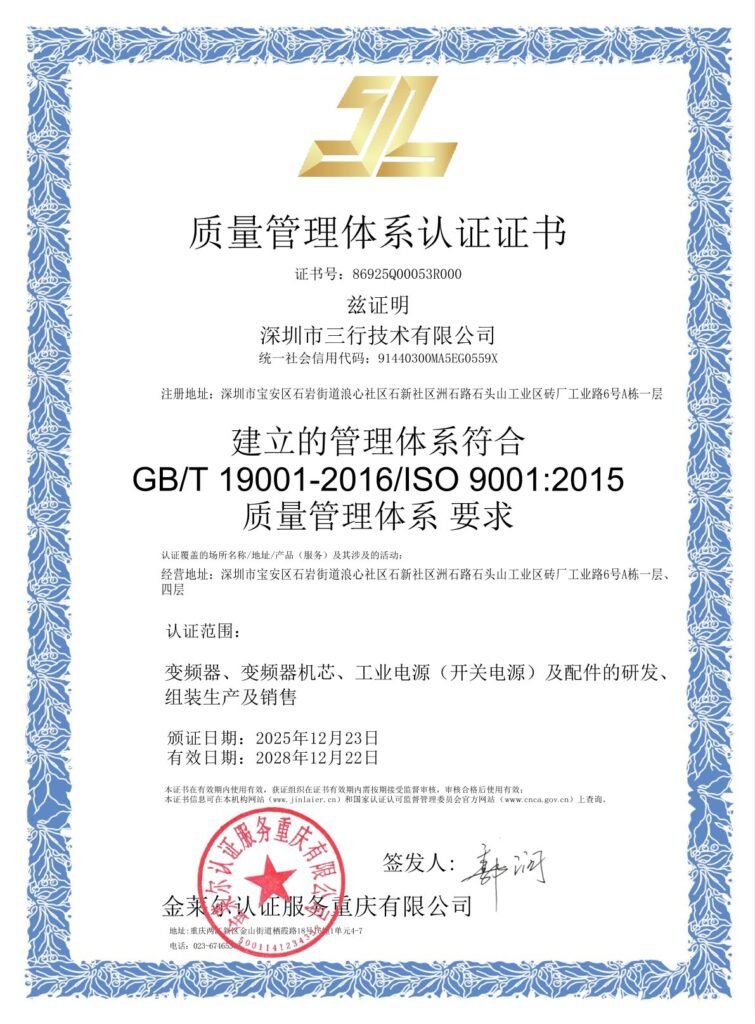
ISO 9001 certification validates that VFD manufacturers maintain standardized production processes and strict quality control systems. It ensures stable product consistency and reliable long-term supply for global clients. Meanwhile, industrial marine and mining VFDs must meet IEEE 519 power quality standards. This controls total harmonic distortion, avoids grid voltage fluctuation and prevents equipment overheating under long-term variable-load operation.
5. Why Full Certification Is Critical for VFD Project Selection
Many industrial buyers overlook full certification compliance when sourcing marine and mining VFDs. This common mistake often leads to project acceptance failure, unexpected equipment shutdowns and potential safety hazards. Non-certified VFDs cannot pass official safety inspections for international mining and marine projects. They are frequently rejected during bidding and project review processes.
In comparison, fully certified VFDs undergo rigorous environmental simulation testing. They deliver stronger anti-corrosion, explosion-proof and anti-interference performance. This greatly reduces on-site failure rates and long-term maintenance costs for industrial operators.
For global industrial buyers, reviewing complete certification documents is the most practical and reliable way to verify whether marine and mining VFDs meet heavy-duty industrial standards. Reputable manufacturers provide full certification reports, type approval files and official test data to support project filing, site inspection and global market access.
Final Summary
In summary, certified marine VFDs prioritize marine classification society approvals such as DNV and ABS. Professional mining VFDs depend on ATEX, IECEx and UL explosion-proof certifications. All heavy-duty industrial VFDs must comply with CE, ISO 9001 and IEEE 519 universal standards to meet global market access and safe operation requirements. If you need fully certified marine or mining VFD solutions tailored to your project, contact our technical team for professional parameter matching and certification verification support.