
Why the question keeps coming up in mining
Walk into any mine substation that runs 6 kV or 10 kV drives and you will hear the same debate: two-level vs. three-level Topology. The two-level design is simpler, cheaper on paper, and every drive supplier ships one. Yet when a hoist has to lift a full skip of ore, when a belt conveyor carries a heavy load up a 15-degree incline, and when harmonic limits at the point of common coupling are being audited, the three-level inverter tends to win. It is not marketing talk. The topology genuinely behaves differently under the conditions mining equipment lives in.
What a three-level inverter actually is
A three-level inverter is a power converter that produces three distinct output voltage levels per phase, instead of the two levels a standard inverter produces.
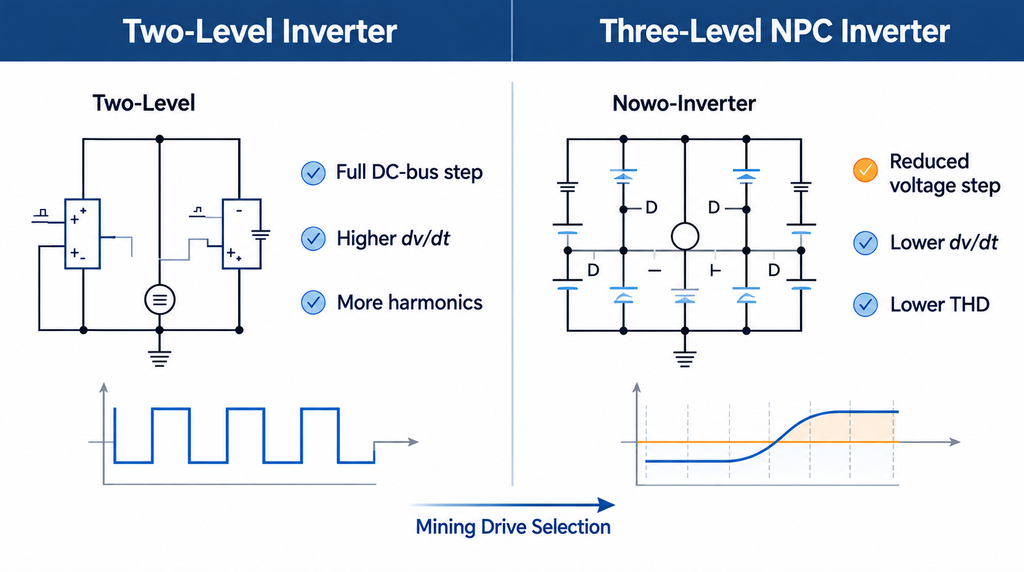
In a two-level inverter, the output of each phase toggles between the positive and negative DC bus rails. The waveform is a square pulse train, and the motor sees the full DC bus voltage jump with every switching action.
A three-level inverter, usually built on the neutral-point-clamped (NPC) topology, splits the DC bus into two halves with a capacitor bank and clamps the output to the midpoint. Each phase can now output three states:
- Positive half (+Vdc/2)
- Zero (the neutral point)
- Negative half (−Vdc/2)
The motor no longer sees the full DC bus voltage in one step. It sees a smaller step, then the neutral point, then the other half. The result is a waveform that is a much closer approximation of a sine wave, with smaller voltage steps and gentler transitions.
This is not a new idea — NPC inverters have been in industrial service since the 1980s. What changed is that power semiconductors and control algorithms have matured enough that medium-voltage drives (1 kV and up) can use the topology reliably and affordably. That is the market segment where three-level really matters, because the DC bus voltage is high enough that a two-level design would force enormous voltage stress on every switching device.
The mechanical reality of switching stress
Here is the part that tends to get skipped in brochure comparisons. When an IGBT switches, it is not just the waveform that changes. The rate of voltage change, the dv/dt, directly affects the motor and the cable.
At medium voltage, a two-level inverter switching between, say, 0 and 5,760 V in a few microseconds produces a very steep voltage front. That steep front travels down the motor cable. If the cable is long, the reflected wave at the motor terminals can overshoot to nearly twice the DC bus voltage. The motor winding insulation takes repeated punishment, and over months the stress shows up as turn-to-turn faults. Bearings also suffer from common-mode voltage and shaft currents, which is why mine maintenance teams find themselves replacing bearings more often than they should.
Three-level switching cuts the voltage step roughly in half. That directly reduces dv/dt, lowers the reflected-wave overshoot, reduces common-mode voltage, and eases the burden on motor insulation and bearings. For a mine hoist that runs hard for two shifts a day for years, this is not a theoretical advantage. It shows up as fewer winding failures and longer intervals between bearing replacements.
Harmonic content: where the cost shows up
Harmonics matter in mining for a practical reason: utilities enforce limits, and mines pay penalties when they exceed them. A two-level inverter, with its larger voltage steps, injects more harmonic content into the line unless you add filter hardware to clean it up. Three-level inverters, by producing a closer-to-sine output, naturally generate lower harmonics. The total harmonic distortion (THD) of the output is lower without needing heavy external filtering.
For a medium-voltage installation, this is a real cost line. If you have to add a sine filter, a line reactor, or an active front end just to pass a harmonic audit, the price gap between two-level and three-level narrows quickly. In many cases the three-level drive comes out cheaper once filtering is accounted for, and it leaves you more headroom on the grid side.
A direct comparison you can take to a spec review
表格
| Aspect | Two-Level Inverter | Three-Level (NPC) Inverter |
|---|---|---|
| Output levels per phase | 2 | 3 |
| Voltage step per switching | Full DC bus | Half DC bus |
| Output voltage waveform | Square pulse train, heavy filtering needed | Closer to sine, lighter filtering |
| Harmonic distortion (THD) | Higher | Lower |
| dv/dt and reflected-wave stress | High | Lower |
| Motor insulation & bearing stress | Higher | Lower |
| Suitable voltage range | Low & some medium voltage | Medium & high voltage (typical 2.3 kV–10 kV) |
| Complexity & cost | Simpler, lower unit cost | More complex, higher unit cost |
| Grid-side filtering cost | Often higher once audited | Often lower net cost |
The honest takeaway: two-level is not “wrong.” Below about 1 kV, or where filtering is cheap and cable runs are short, it is often the pragmatic choice. Three-level earns its keep the moment you are at medium voltage, running long cables, or dealing with harmonic limits. Mining hits all three at once.
Why mining operations specifically prefer three-level
Mining is a demanding application for drives, and not in the way that looks impressive in a datasheet. Consider the actual conditions:
Heavy, constant load. A hoist or a conveyor runs at a steady, high torque for hours. This is the opposite of the variable, lightly loaded profile most drives are designed around. The drive has to deliver clean torque continuously, and any harmonic or commutation weakness shows up as heat and losses over long shifts.
Long cables. Underground, the drive is often separated from the motor by long cable runs — sometimes hundreds of meters. This is exactly where reflected waves and dv/dt stress become a winding-killer. The lower dv/dt of a three-level drive is a direct safeguard.
Harsh electrical environment. Mines have poor, fluctuating power quality. Voltage sags, transients, and unbalanced supply are normal. A three-level drive, with a split DC bus and more control headroom, tolerates supply disturbances better and keeps the process running when a two-level drive might fault out.
Harmonic audits and penalties. Mining sites are big, continuous loads. Power quality at the utility metering point is monitored. Exceeding harmonic limits is a fine, not a recommendation. Lower intrinsic THD is a compliance advantage.
Hazardous and difficult maintenance. A failed drive in an underground mine is not swapped in an afternoon. Spares are hard to move, access is constrained, and downtime costs more per hour than almost any other industry. Reliability and reduced component stress are worth real money here.
None of these alone forces three-level. Together, they tip the decision.
When three-level is the wrong answer
It is worth being direct about the downside, because a one-sided article helps nobody. Three-level NPC inverters are more complex, with more semiconductor devices and a capacitor bank that needs proper management and balancing. The unit cost is higher. If your application is low voltage, short cable, and tolerant of harmonics, you may be paying for capability you do not use.
So the rule of thumb is not “always three-level.” It is: choose three-level at medium voltage, with long cable runs, continuous heavy load, or harmonic limits. That is the exact profile of mine hoists, mine winders, scraper conveyors, and main belt conveyors. Which is why, in practice, three-level has become the mainstream answer for medium-voltage mining drives rather than a premium option.
What to look for in a three-level medium-voltage drive
If you are in the middle of specifying one, here are the checks worth running, beyond the topology label on the datasheet:
- Voltage rating that matches the motor nameplate. A drive rated for your system voltage (for example 660 V, 1,140 V, 3.3 kV, 6 kV, or 10 kV) rather than one you will have to derate.
- Real control performance on heavy torque. Vector or field-oriented control that holds torque at low speed, since hoists and conveyors start under load.
- Harmonic numbers, not adjectives. Ask for measured THD figures at the operating point, not a marketing percentage.
- Insulation and bearing protection. Design that addresses dv/dt and common-mode voltage, because that is where long-term reliability is won or lost.
- Switching device selection and thermal design. In a mine, a drive that derates in ambient heat is a liability.
- Support and delivery you can plan around. In mining, a drive is a production asset. Know the lead time, the spare parts situation, and who answers the phone when a fault code appears underground.
Three-level drives built for mining, from Sunsin
Sunsin has been building medium-voltage variable frequency drives for exactly these conditions. The SD650 medium-voltage mine drive is a three-level design covering 660 V through 10 kV, aimed at hoists, winders, conveyors, and scraper conveyors. It is backed by the company’s engineering base of eight invention patents and thirty utility model patents, and every unit is configured around the customer’s actual motor and site rather than sold as a generic box.
Two things that matter practically in a mining project: Sunsin can deliver a technical proposal within two weeks of receiving the site and motor details, and the finished drive ships within about 45 days. For a mine that cannot stop production to wait on a six-month lead time, that is a planning advantage. Hardware, software, structure, and enclosure can all be customized to suit a specific installation, including hazardous-zone requirements.
If you are sizing a drive for a hoist or conveyor and want to talk through the torque, cable length, and harmonic constraints of your site, the engineering team can be reached at sunsinchina@163.com.
FAQ
What voltage levels can a three-level inverter handle? Three-level NPC inverters are used from roughly 2.3 kV up to 10 kV and higher. The topology’s advantage grows with voltage because it halves the per-step stress that would otherwise crush a two-level design at medium and high voltage.
Is a three-level inverter always better than two-level? No. Below medium voltage, with short cables and tolerant harmonic limits, two-level is often cheaper and simpler. Three-level wins when voltage is higher, cables are longer, load is heavy and continuous, or harmonic limits are tight — which is the typical mining profile.
Does three-level remove the need for output filters? It reduces the filtering burden significantly because the output is closer to a sine wave and dv/dt is lower. It does not always eliminate all filtering, but the net filtering cost is usually lower than with two-level.
Why do mine hoists specifically use three-level drives? Hoists run heavy torque for long shifts, over long cables, in a harsh electrical environment, where downtime is extremely expensive. The lower dv/dt, lower harmonics, and better supply tolerance of three-level directly address those conditions.
What is NPC in a three-level inverter? NPC stands for neutral-point-clamped. The DC bus is split with a capacitor bank, and the output is clamped to the midpoint, giving each phase three output levels instead of two.
How does a three-level inverter protect motor insulation? By halving the voltage step per switching action, it reduces dv/dt and reflected-wave overshoot at the motor terminals. That means far less stress on winding insulation and bearings over the life of the motor.