
When engineers select industrial inverter cabinets, VFD drive systems, or PMSM motor drives for mining, water pumping, industrial fan, and solar pump projects, most focus heavily on power capacity, control precision, and communication compatibility. However, one critical specification is often overlooked: the cabinet IP protection grade.
Choosing the wrong IP rating is one of the most common causes of unexpected drive failure, frequent downtime, and shortened equipment lifespan. Selecting an overrated cabinet also leads to unnecessary cost waste and overheating risks, while an underrated enclosure cannot withstand harsh site conditions such as heavy dust, humidity, or splashing water.
IP stands for Ingress Protection, defined by the global IEC 60529 standard. The two-digit rating clearly defines a cabinet’s ability to resist solid particles and water exposure. Among all industrial grades, IP20, IP54, and IP65 are the three most widely adopted standards for inverter and VFD drive cabinets.
This guide explains the real-world differences between IP20, IP54, and IP65, breaks down their practical pros and cons, and helps you select the most suitable protection grade for industrial and renewable energy drive projects.
What Do IP20, IP54, and IP65 Mean for Inverter Cabinets?
Many buyers only understand IP ratings from basic definitions, but they ignore how each grade actually performs on industrial sites. Below is a practical, site-oriented explanation for inverter cabinet applications.
IP20: Indoor Basic Protection Grade
IP20 offers protection against finger contact and large solid objects larger than 12.5mm. It prevents accidental human touch to internal live components, ensuring basic operation safety. However, it provides no dust resistance and no water resistance.
IP20 cabinets adopt open ventilation design with natural and forced air cooling. This structure ensures excellent heat dissipation for high-power inverter modules, keeping the drive system running at stable temperatures during long-hour continuous operation. It is low-cost, lightweight, and easy to install and maintain.
That said, IP20 enclosures cannot block fine dust, moisture, or any water splashes. Once deployed in dusty or humid environments, internal circuit boards will accumulate dust rapidly, leading to poor heat dissipation, leakage, or short-circuit faults.
IP54: Balanced Protection for General Industrial Environments
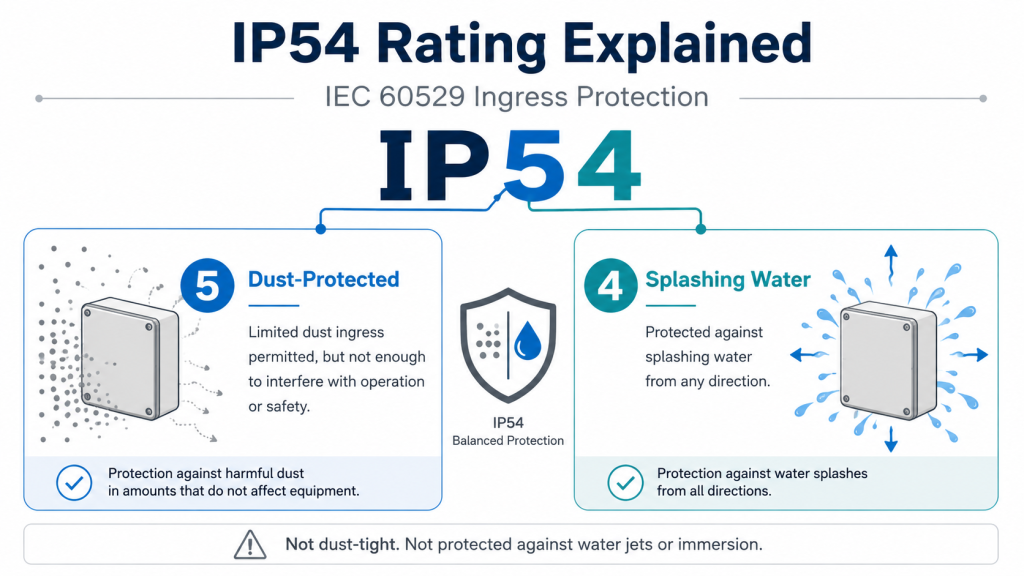
IP54 is the most versatile grade for standard industrial drive cabinets. The first digit “5” means dust-protected: fine dust may enter the cabinet in small amounts, but not enough to affect normal equipment operation. The second digit “4” provides full-direction splash resistance, protecting the internal system from splashing water, condensed moisture, and light rain spray.
Different from fully open IP20 cabinets, IP54 enclosures use filtered ventilation holes. The filter cotton blocks most industrial dust while maintaining smooth airflow for heat dissipation. This balanced design delivers better environmental adaptability than IP20, without the high cost and closed-loop cooling limits of IP65 cabinets.
IP54 works perfectly for factory workshops, sheltered equipment areas, semi-outdoor covered stations, and general industrial sites with moderate dust and humidity. It is the mainstream choice for most fan drives, water pump drives, and common conveyor drive systems.
IP65: Full Dust-Tight & Water-Jet Resistant Grade for Harsh Conditions
IP65 is the highest commonly used standard for outdoor and heavy-duty industrial inverter cabinets. The first digit “6” means 100% dust-tight, allowing zero dust ingress. The second digit “5” ensures resistance against low-pressure water jets from all directions, enabling the cabinet to withstand heavy rain, wind-driven spray, and manual water washing.
Unlike IP20 and IP54, IP65 cabinets adopt fully sealed structures with rubber gaskets, sealed cable glands, and waterproof HMI panels. Since traditional fan ventilation is unavailable, IP65 high-power inverters are equipped with heat exchangers or closed-loop cooling systems to solve heat dissipation problems.
Although IP65 provides superior protection, it comes with higher manufacturing costs, heavier cabinet weight, and stricter thermal design requirements. It is specially built for open-air outdoor environments, heavy-dust mining sites, coastal humid areas, and renewable energy solar pump projects exposed to the weather.
IP20 vs IP54 vs IP65: Core Performance Comparison
| Protection Grade | Dust Resistance | Water Resistance | Cooling Method | Best Application |
|---|---|---|---|---|
| IP20 | Only blocks large objects, no fine dust protection | No water protection | Open forced air cooling, excellent heat dissipation | Clean indoor electrical rooms, control rooms |
| IP54 | Dust-proof with filter ventilation | Splash-proof in all directions | Filtered air cooling, balanced performance | Workshops, covered semi-outdoor areas |
| IP65 | Fully dust-tight | Resists water jet spray and heavy rain | Closed heat exchanger cooling | Outdoor, mining, coastal, solar pump sites |
How to Choose the Right IP Grade for Your Inverter Cabinet
Choose IP20 for Clean Indoor Controlled Environments
IP20 is the most cost-effective option for fully enclosed, clean, and dry electrical control rooms. If your inverter or VFD cabinet is placed in a dedicated indoor power distribution room with stable temperature, low dust, and no moisture splash risk, IP20 is completely sufficient.
Most indoor rectifier-inverter integrated cabinets and indoor PMSM drive cabinets adopt IP20 as standard. Its open ventilation structure guarantees long-term stable heat dissipation, effectively avoiding over-temperature faults during 24/7 continuous operation. There is no need to pay extra for unnecessary waterproof and dustproof functions.
Choose IP54 for General Industrial & Sheltered Sites
IP54 is the ideal middle-ground solution for most industrial automation projects. It fits ordinary factory floors, underground mining tunnels with medium dust, covered equipment platforms, and sheltered solar pump stations.
For industrial fan drives, water pump variable frequency drives, and conveyor system inverters installed indoors or under eaves, IP54 effectively blocks workshop dust and accidental water splashes. Compared with IP20, it greatly improves environmental adaptability. Compared with IP65, it retains natural air convection cooling, avoiding overheating problems caused by fully sealed structures.
Note: IP54 filter cotton requires regular cleaning and replacement. Neglected maintenance will cause airflow blockage and heat accumulation.
Choose IP65 for Outdoor & Harsh Heavy-Duty Conditions
If your drive equipment is exposed to open air, rainy weather, strong wind dust, or needs regular water cleaning, IP65 is the only reliable choice. Typical scenarios include outdoor solar pumping systems, open mining conveyor drives, coastal water supply projects, and field renewable energy conversion stations.
The fully sealed IP65 structure completely isolates dust, rain, and humid salt mist, protecting internal precision IGBT modules and control circuits from corrosion and contamination. For outdoor renewable energy projects that require years of unattended operation, IP65 is the essential standard to ensure long service life and low failure rate.
Common IP Rating Selection Mistakes to Avoid
Many project failures stem from incorrect IP grade selection rather than product quality issues.
First, blind over-specification. Many engineers choose IP65 for all projects for safety. In fact, IP65 sealed cabinets installed indoors easily cause poor heat dissipation, triggering over-temperature alarms. Over-specification increases procurement costs while reducing operational stability.
Second, misunderstanding IP functions. IP65 is water-jet resistant, not submersible. It cannot work under long-term water immersion. Flood-prone sites need height installation and drainage design instead of relying solely on IP grades.
Third, ignoring assembly quality. A nominal IP65 cabinet with poor gaskets, loose cable glands, or unqualified panel sealing will lose its protection performance. The complete cabinet assembly determines the actual IP level, not just the shell.
Conclusion
IP20, IP54, and IP65 each have their unique application value. IP20 delivers low cost and excellent cooling for clean indoor rooms. IP54 provides balanced dust and splash protection for standard industrial environments. IP65 offers full dust-tight and waterproof performance for outdoor and harsh working conditions.
The best IP rating is not the highest one, but the most matching one for your on-site environment. Proper selection effectively reduces failure rate, cuts maintenance costs, and extends the service life of industrial VFD drives, PMSM inverter cabinets, and renewable energy power conversion equipment.
FAQ
Q1: Can IP54 cabinets be used outdoors?
A1: Only for sheltered outdoor areas without direct rain or strong dust exposure. Fully open outdoor installation requires IP65.
Q2: Is IP65 cabinet hotter than IP20?
A2: Without professional heat-exchanger design, yes. High-quality IP65 inverter cabinets adopt dedicated closed-loop cooling systems to ensure stable temperature operation.
Q3: Can I upgrade IP20 to IP54 or IP65 on site?
A3: No. IP rating depends on overall cabinet structure, sealing gaskets, and ventilation design. On-site modification cannot achieve standard certified protection levels.