
Mining operations face unique operational hurdles every single day. From long-distance belt conveyors transporting raw ore across rugged terrain to heavy-duty hoists lifting thousands of tons up vertical mine shafts, mining machinery runs under extreme, fluctuating heavy-load conditions. Sudden load spikes, frequent start-stop cycles, dust, vibration and unstable power supply all threaten equipment safety, production continuity and overall operational expenditure. Variable Frequency Drives (VFDs), also known as variable speed drives, have become the core control hardware to resolve these pain points for modern mining conveyor and hoist systems. Many mine operators retrofitted traditional direct-on-line motor systems with heavy-duty VFD cabinets over the past decade, achieving smoother motor control, lower mechanical wear and measurable energy savings.
Why mining conveyors and hoists demand special heavy-load VFD
Standard general-purpose VFDs designed for fan or pump applications cannot handle mining heavy-load scenarios. Conveyors and mine hoists feature high starting torque requirements. When a loaded mining belt conveyor starts up, the motor needs enough torque to overcome static friction of the entire belt plus the weight of stacked ore. A regular drive may trigger over-current alarms during startup, leading to unexpected tripping and production halt. For mine hoists, load changes are even more complex: lifting loaded cages creates peak heavy load, while empty cage return brings regenerative energy flowing back into the drive system.
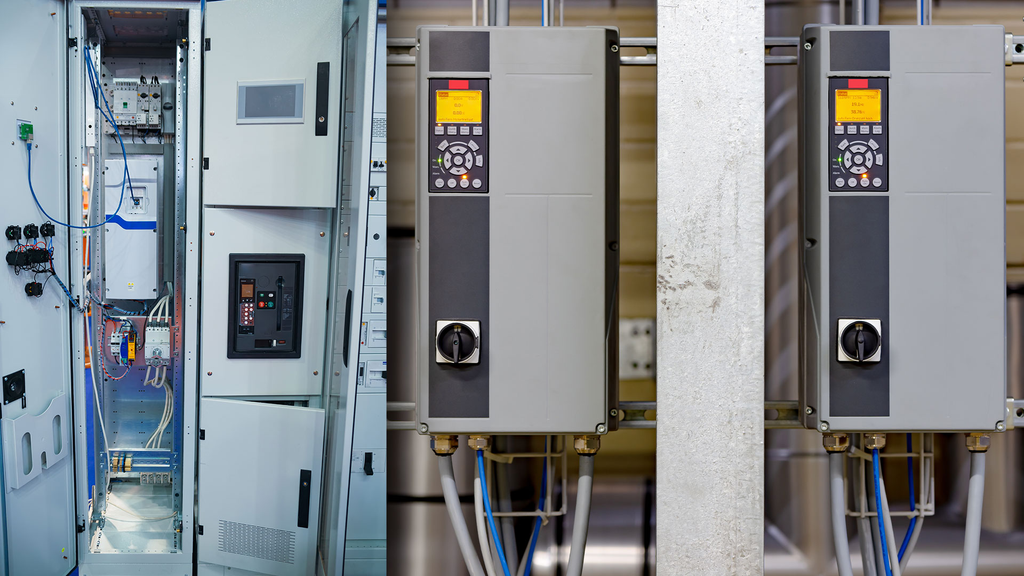
Mining sites also present harsh environmental challenges. High concentrations of mineral dust, humidity, large temperature shifts and continuous mechanical vibration will damage ordinary inverter components. Heavy-duty mining VFD cabinets adopt reinforced enclosure protection, commonly IP54, to block dust and splashing water. Internal circuit boards get anti-vibration reinforcement and special coating against corrosion. Unlike light industrial drives, mining grade VFD hardware also includes redundant protection functions to prevent catastrophic failure under shock load.
Direct-on-line (DOL) starting was widely adopted in older mining sites. DOL launches the motor at full voltage instantly. The huge inrush current creates severe shock to the power grid, while mechanical impact puts massive stress on belts, gearboxes, bearings and couplings. Frequent shock accelerates component fatigue, shortening the service life of expensive conveyor belts and hoist mechanical parts. Maintenance teams often spend long hours fixing broken belts or worn gear assemblies, bringing costly downtime to mining production.
VFDs eliminate this mechanical and electrical shock completely. The drive ramps motor speed up and down gradually within adjustable acceleration and deceleration time. Soft start reduces starting current to a controllable level, protects grid stability and cuts mechanical impact on transmission parts. For long belt conveyors, multi-drive synchronous control function of mining VFDs keeps multiple drive motors running at matched speed and balanced torque, preventing belt slip or tension imbalance which may tear the conveyor belt.
VFD working principle on mining belt conveyor systems
Large mining conveyors usually install two or more drive motors at head and tail positions. Heavy-load VFD systems perform torque balance control for all drive points. When ore stacking weight changes along the belt, each drive unit automatically adjusts output torque in real time. This prevents one motor taking excessive load while another runs idle, a common fault causing motor burnout or belt damage.
Smooth speed adjustment is another core benefit. Mine operators can tune conveyor running speed according to ore feed volume. If the raw ore supply drops, the conveyor can slow down automatically instead of running constantly at full speed. This directly cuts power consumption. Many mining projects record 15% to 30% energy saving after VFD retrofit on belt conveyors.
VFDs also deliver reliable protection for conveyor systems. Built-in monitoring tracks motor current, temperature, torque and voltage continuously. Once abnormal parameters appear, the VFD triggers alarm or controlled shutdown rather than sudden hard stop. Controlled slow stop is critical for loaded long conveyors. Emergency hard stop may cause material stacking, belt folding or even belt rupture. With VFD soft stop function, the belt decelerates steadily to reduce accident risks.
For uphill and downhill conveyor routes, regenerative VFD models are strongly recommended. Downhill conveyors carry ore downward, and gravity pulls the belt forward. The motor turns into generator mode, generating surplus energy. Regenerative VFD feeds this recovered electric energy back to the site power grid, instead of wasting energy as heat through braking resistors. This cuts thermal load inside the cabinet, reduces cooling system pressure and lowers long-term power bills.
VFD control for mine hoist heavy-load operation
Mine hoists are classified as critical safety equipment. Safety reliability is the top priority when selecting VFD solutions. Hoist VFD must maintain stable torque output at low speed. When lifting heavy ore cages at low velocity, the drive still holds steady torque to avoid cage slipping. Torque control accuracy directly decides hoist operation safety.
Regenerative VFD becomes almost mandatory for mine hoist applications. During cage lowering, gravitational potential energy converts back into electric power. Traditional resistor braking dissipates all recovered energy as heat, raising cabinet temperature and increasing cooling fan load, which brings extra maintenance work. Regenerative VFD transfers the surplus power back to plant grid, reducing total energy usage and avoiding overheating issues inside the cabinet.
Hoist VFD systems integrate multiple safety interlock functions. They work together with brake systems, position sensors and emergency stop circuits. The drive can coordinate motor torque and mechanical brake action to prevent load slipping during brake engagement and release. High-precision speed control also supports accurate cage positioning, helping operators stop the hoist cage at the target loading and unloading level.
Hoist VFD cabinets usually use medium voltage (MV) drive designs for high power hoist equipment. Low voltage drives suffer high current at large power ratings, requiring thick cables and bringing higher cable loss. Medium voltage VFD systems reduce operating current, lower cable cost and cut transmission loss for high power mine hoist motors. For ultra-large mine hoist with power over 10MW, project engineers will evaluate high voltage (HV) drive options based on site power infrastructure and total ownership cost.
Key parameters when selecting VFD for mining conveyor and hoist
- Rated power and rated current Do not simply match VFD rated power with motor nameplate power. Mining heavy load has frequent overload conditions. Select VFD with 1.1 or 1.2 times overload capacity for general conveyor use. Hoist application often requires 1.5 times overload capability for short duration, to handle sudden heavy load impact. Continuous rated current of VFD must exceed motor rated current to reserve safety margin.
- Enclosure protection rating IP54 is the most common selection for mining surface and underground sites. It protects equipment from dust accumulation and splashing water. If deployed in extremely dusty underground tunnels or areas with water spraying, users may upgrade to IP65 cabinets. Standard IP20 cabinet is only suitable for clean, enclosed control rooms and not fit for direct field installation in mining zones.
- Control type Torque vector control is preferred over simple V/F control for mining conveyors and hoists. Vector control maintains stable torque output at low motor speed, which is essential for heavy load startup. Some high-end mining VFD supports sensorless vector control, removing reliance on motor encoders and lowering wiring and maintenance cost. Hoist applications with ultra-high precision positioning usually keep encoder feedback for closed-loop control.
- Regenerative function requirement Assess whether the system generates regenerative energy. Downhill conveyors and mine hoists produce large regenerative power. In such cases, regenerative VFD is a better long-term solution than resistor braking units. Flat uphill conveyors without obvious regeneration may use standard VFD plus braking resistor for cost control.
- Communication and remote monitoring Modern mining sites adopt central control room management. VFD should support common industrial communication protocols such as Modbus, Profinet. Operators can check running status, historical fault records and real-time data remotely, set parameters or perform troubleshooting without going into hazardous underground mining zones.
Common on-site challenges and VFD solution troubleshooting
Even with high-quality mining VFD systems, site engineers meet several typical issues. Harmonic distortion is a well-known problem when deploying large power VFDs in mining plants. VFD switching action introduces harmonic noise into local power grid, which may interfere with nearby instruments and electronics. Multi-level topology medium voltage VFD can suppress harmonic output. For projects with strict grid requirement, harmonic filters can be added together with VFD cabinets.
VFD overheating is another frequent fault. Mining dust sticks to cooling fans and heat sinks, blocking heat dissipation. Regular cleaning schedule must be included into maintenance plans. Heavy-duty mining VFD designs use larger heat sinks and reinforced cooling fans. Some high-power MV cabinets adopt liquid cooling for sites with high ambient temperature.
Vibration caused by mining operation may loosen wiring terminals or damage electronic components. Mining VFD cabinets use anti-vibration structure, locking terminals and conformal coated circuit boards. During installation, cabinets should be fixed firmly on vibration isolation bases. Routine inspection of wiring tightness helps prevent sudden shutdown failures.
Real mining project reference
A mining operator in Central Asia upgraded three long belt conveyors with Sunsin medium voltage heavy-load VFD cabinets. Before retrofit, the site often faced belt tension imbalance and frequent over-current trips at startup. After VFD installation, multi-motor torque balance control solved uneven load distribution. Startup shock was removed, belt replacement cycle extended, and site power consumption reduced by 22%. The regenerative VFD units on downhill conveyor recovered gravitational energy back to grid, cutting heat emission inside control cabinet and reducing cooling fan operation hours.
Another underground mine hoist project adopted Sunsin regenerative MV VFD system. The old resistor braking setup generated massive heat in the control room and required frequent resistor replacement. The new VFD solution feeds regenerative power back to grid, lowering heat load greatly. Precise low-speed torque control improved hoist safety, and remote data monitoring helps maintenance team predict potential faults ahead of failure.
Total cost of ownership analysis
Many buyers only compare initial purchase price of VFD cabinets during procurement. But for mining heavy-load equipment, total cost over equipment lifecycle carries more weight. High quality heavy-duty mining VFD may cost more upfront, yet it reduces mechanical maintenance expense, extends service life of belts, gearboxes and motors, and delivers continuous energy savings. Less unexpected downtime also avoids massive production losses.
General-purpose light load VFD has low initial price but cannot survive mining harsh environment. It suffers frequent breakdowns and requires repeated repair or replacement. The accumulated maintenance cost plus production loss will far exceed the price difference of industrial heavy-duty grade VFD.
Conclusion
Heavy-load VFD solutions become indispensable infrastructure for modern mining conveyor and hoist control. They resolve pain points including violent startup shock, unstable torque, excessive mechanical wear and high power consumption. The right VFD selection, whether standard heavy-duty model or regenerative MV/HV drive, relies on full evaluation of load characteristics, site environment, power grid condition and project budget.
When planning new mining conveyor or hoist projects, or preparing equipment retrofit, working with professional VFD manufacturers who hold rich mining project experience will lower technical risk. Experienced suppliers can provide customized cabinet design, on-site commissioning, operator training and long-term after-sales support. Reliable variable frequency drive system protects mining equipment, stabilizes continuous production and brings tangible energy saving benefits for mining operators worldwide.