
In industrial frequency conversion renovation projects, most users are confused about the selection between four-quadrant VFD andordinary VFD. On the surface, both types of variable frequency drives can realize motor speed regulation, but their internal topological structure, energy processing logic and applicable working conditions are completely different. Choosing the wrong VFD type will lead to frequent overvoltage tripping, serious energy waste, or even accelerated aging of motors and power distribution equipment.
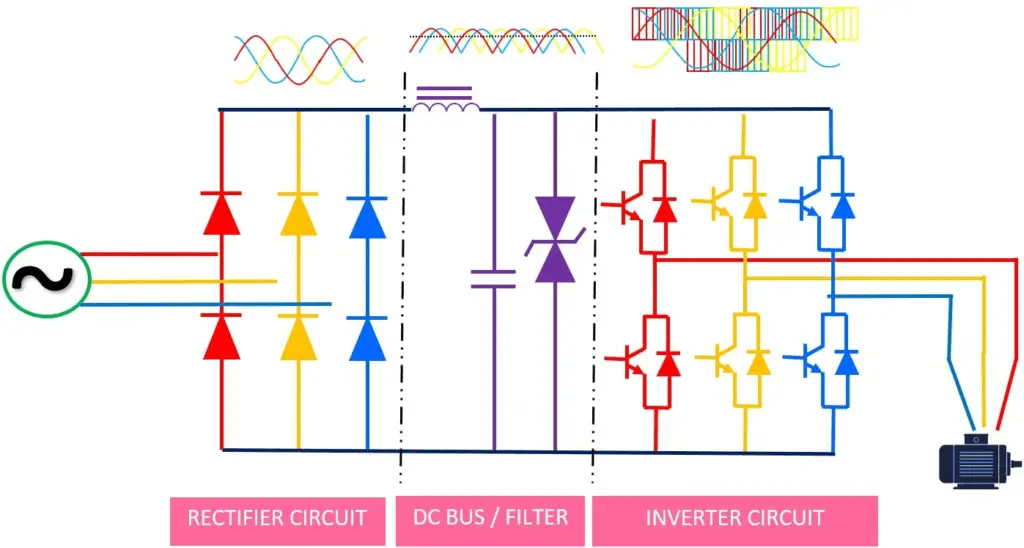
Simply put, ordinary VFDs are designed for stable motoring operation, suitable for constant-speed and steady-load equipment. In contrast, four-quadrant VFDs support bidirectional energy flow, which can handle frequent braking, inertial load feedback and forward-reverse switching working conditions. This article clearly explains the core difference between four-quadrant and ordinary VFDs from working principle, structural design, operation mode and industrial application scenarios, helping engineers make accurate model selection for medium and high voltage industrial projects.
1. Basic Definition & Operating Logic
1.1 Ordinary VFD (Two-Quadrant Drive)
Conventional ordinary VFDs belong to two-quadrant operation devices. Their core working logic is one-way energy transmission: the grid inputs electric energy to the VFD, and the VFD converts and outputs power to drive the motor to rotate. During the entire operation process, energy can only flow from the power grid to the load side, without reverse feedback capability.
When the motor decelerates or stops, the inertial rotation of the load will generate regenerative electric energy. Since the ordinary VFD cannot feed energy back to the grid, the redundant electric energy will be accumulated on the DC bus, causing the bus voltage to rise rapidly. This is the main reason why ordinary drives often report overvoltage faults during deceleration, especially for high-inertia loads such as large fans and belt conveyors.
1.2 Four-quadrant VFD (Regenerative Drive)
A four-quadrant VFD is a high-performance regenerative variable frequency drive that supports full four-quadrant operation. It can not only receive grid energy to drive the motor forward and reverse, but also convert the regenerative electric energy generated by motor braking and inertial operation into stable AC power and feed it back to the grid. This bidirectional energy flow capability is the most essential difference from ordinary VFDs.
It covers four core operating states: forward motoring, forward braking, reverse motoring and reverse braking. Whether the equipment is accelerating, decelerating, starting or stopping frequently, the four-quadrant drive can maintain stable voltage and current output without energy accumulation, completely solving the overvoltage trip problem of traditional VFDs.
2. Core Structural & Working Principle Differences
2.1 Rectifier Module Design
Ordinary VFDs adopt unidirectional diode rectifier modules. The rectifier part only undertakes the function of converting AC to DC, and cannot realize reverse current output. The structure is simple and the cost is low, which is enough to meet the operation requirements of general steady loads.
Four-quadrant VFDs use fully controllable active rectifier modules instead of ordinary diodes. The front-end rectifier unit and the rear-end inverter unit adopt symmetrical design, which can switch working states in real time according to load changes. When the motor is in motoring state, it rectifies grid power; when braking, it inverts DC energy into AC power and feeds it back to the grid.
2.2 Braking Energy Processing Method
This is the most practical difference in on-site operation. For ordinary VFDs, to avoid overvoltage during deceleration, users can only install external braking resistors. The regenerative energy is consumed in the form of heat through the resistors. This method not only causes serious energy waste, but also increases on-site temperature, dust accumulation and equipment aging risks, and requires regular maintenance of braking resistors.
Four-quadrant VFDs completely abandon resistor heat dissipation. All regenerative energy is recycled and fed back to the power grid for reuse. No heat loss is generated during braking, which realizes real energy recycling. For industrial equipment with frequent start-stop and reciprocating operation, the energy-saving effect is extremely significant.
2.3 Power Quality & Anti-interference Performance
Ordinary VFDs have uncontrollable rectification links, which will generate certain harmonic pollution during operation, resulting in low grid power factor. For ordinary fan and pump loads, the impact is negligible, but for high-precision industrial parks and high-power intensive equipment scenarios, long-term operation will cause grid voltage distortion.
Four-quadrant medium voltage drives adopt advanced PWM active rectification technology, which can automatically adjust current phase and amplitude. It effectively suppresses grid harmonics, improves power factor close to 1, and has strong adaptability to fluctuating industrial power grids. It will not cause interference to other precision equipment in the factory.
3. Load Adaptability & On-site Performance Comparison
3.1 Ordinary VFD: Suitable for Steady and Single-direction Loads
Ordinary VFDs are ideal for constant-torque and variable-torque loads with stable operation and no frequent braking. Typical applicable equipment includes conventional ventilation fans, water supply pumps and fixed-speed operating mechanical equipment. These devices run stably in a single direction for a long time, with little inertial feedback energy, and ordinary VFDs can fully meet the demand with lower procurement cost.
However, once facing frequent deceleration, sudden stop or forward-reverse switching working conditions, ordinary VFDs are prone to overvoltage tripping, unstable speed regulation and excessive heat generation. Long-term forced operation will reduce the service life of power modules and increase failure frequency.
3.2 Four-quadrant VFD: Tailored for Complex Dynamic Loads
Four-quadrant VFDs excel in complex working conditions with large inertia, frequent start-stop and reciprocating operation. In mining, marine, metallurgical and oilfield industries, many heavy-duty equipment will generate a large amount of regenerative energy during operation. Traditional ordinary VFDs cannot digest this energy, resulting in unstable system operation.
Mining belt conveyors, cranes, oil pumping units and marine propulsion equipment all require four-quadrant drive support. It maintains smooth speed switching, eliminates braking impact, and realizes efficient energy recovery. While ensuring equipment safety and stability, it greatly reduces comprehensive power consumption.
4. Comprehensive Advantages of Four-quadrant Regenerative VFD
Compared with ordinary VFDs, the upgrade advantages of four-quadrant drives are not limited to braking energy recovery, but also cover full-cycle operation optimization.
First, higher operation stability. Bidirectional energy balance avoids DC bus voltage surge, eliminates overvoltage and overcurrent faults caused by load mutation, and supports long-term heavy-load continuous operation.
Second, significant secondary energy saving. In addition to the basic speed regulation and energy saving of ordinary VFDs, four-quadrant drives can recover 15%-30% of braking energy, bringing more considerable economic benefits for frequent operating equipment.
Third, lower maintenance cost. No need to install and replace braking resistors, reducing on-site heat source and dust accumulation. The whole system runs with low loss and low aging rate, greatly reducing later maintenance workload and replacement cost.
Fourth, better grid protection. Low harmonic output and high power factor operation effectively optimize factory power quality, avoiding grid pollution and equipment resonance problems caused by ordinary VFDs.
5. How to Choose: Four-quadrant VFD or Ordinary VFD?
For industrial users, there is no absolute better product, only more suitable equipment. For conventional steady-load equipment such as ordinary fans and water pumps, ordinary VFDs with cost-effective performance are sufficient, which can avoid redundant investment.
If your project involves frequent start-stop, forward-reverse switching, high-inertia braking and long-term heavy-load operation, four-quadrant regenerative VFDs must be selected. Typical applicable scenarios include mining conveyors, metallurgical rolling equipment, marine power systems, oilfield pumping units and industrial lifting equipment.
In high-standard industrial projects that require grid quality assessment and long-term low-cost operation, four-quadrant medium voltage drives are also the preferred solution, which can balance stability, energy saving and grid compatibility.
Conclusion
The core difference between four-quadrant and ordinary VFD lies in energy transmission mode and load adaptability. Ordinary VFDs focus on unidirectional speed regulation and are suitable for simple and stable working conditions, while four-quadrant regenerative VFDs realize bidirectional energy flow, solving the pain points of braking energy waste and unstable operation of heavy-duty equipment.
SUNSIN four-quadrant medium and high voltage three-level VFDs adopt mature active rectification technology, perfectly adapting to complex and harsh industrial working conditions such as mining, marine and petrochemical industries. While ensuring 24/7 stable operation of equipment, it maximizes energy recovery efficiency, helping global industrial users reduce operating costs and achieve green and efficient production upgrading.