
When selecting drive equipment for mining conveyors and mine hoists, engineers often compare a three-level VFD against conventional two-level variable frequency drives to balance uptime, power quality and long-term maintenance costs. Mining sites operate under extreme conditions: continuous heavy loads, pervasive dust, large temperature fluctuations, and fragile on-site power networks. In this harsh operating environment, the decision between a two-level drive and an ANPC three-level VFD is not merely a technical detail. It directly shapes maintenance schedules, energy consumption and overall equipment downtime.
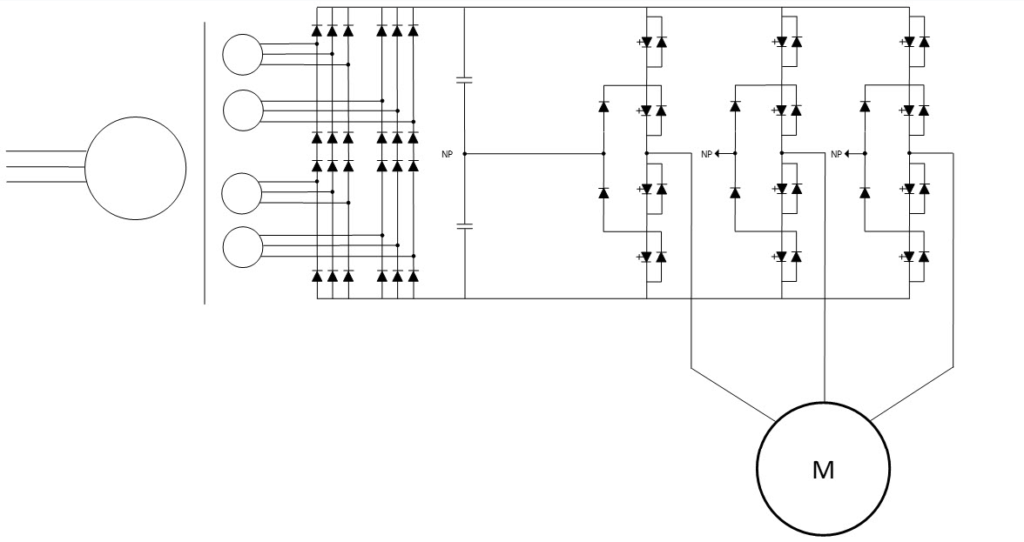
This practical guide compares these two topologies on the factors that matter most for underground mining operations, including harmonic performance, motor insulation stress, heavy-load reliability, cooling schemes and total ownership cost. If you are specifying drives for conveyors, hoists or crushers, this framework helps you move beyond raw datasheet comparison and make a field-proven selection.
What the two-level VFD does well, and where it starts to struggle
The two-level VFD has been the workhorse of industrial speed control for decades. Its circuit is simple: each phase output switches between the positive and negative DC bus, and the motor sees a stepped voltage waveform. That simplicity keeps the initial purchase price low and the repair logic familiar to most maintenance teams. For fans, pumps, and light conveyors running on a clean supply, it is still a reasonable choice.
The trouble appears when the load is heavy and the site is hostile. A two-level drive produces a higher dv/dt — the rate at which voltage changes at the motor terminals. On long cable runs, that steep edge causes reflected voltage spikes, which stress motor winding insulation and, over time, shorten motor life. It also injects more current harmonics back into the supply, which heats up transformers and can trip sensitive upstream protection. None of this shows up on day one. It accumulates.
Mining is exactly the case where that accumulation matters. A conveyor motor that runs twenty hours a day does not tolerate insulation that fails at month thirty because of voltage spikes you never saw. Two-level drives remain in wide use, but for heavy, continuous, high-power mining loads, their weaknesses get expensive.
What makes the ANPC three-level VFD different
The ANPC (Active Neutral-Point Clamped) three-level topology is a different class of drive. Instead of two voltage steps per phase, it produces three. The extra step smooths the output waveform, which lowers dv/dt and reduces harmonic content at the source.
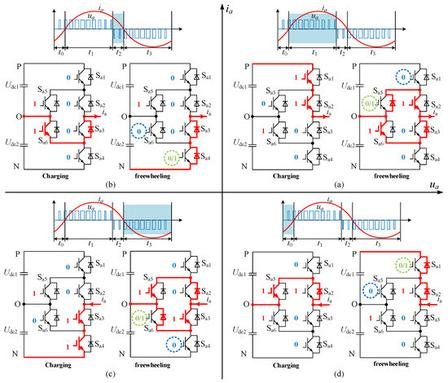
The “active” part of ANPC matters as much as the third level. In a standard NPC three-level inverter, the neutral-point voltage can drift under unbalanced load, which stresses the DC-link capacitors and the devices themselves. ANPC replaces part of the clamping network with active switching devices, giving the controller direct control over the neutral-point voltage. The result is a drive that keeps its DC-link balanced even when the load changes suddenly — the kind of condition a mine hoist creates every time it starts or reverses.
The practical payoff is not a better datasheet. It is a motor that runs cooler, winding insulation that survives longer, and a supply network that stays quiet enough that neighboring equipment stops tripping.
Harmonics — where three-level drives quiet the grid
Harmonics are the most visible difference between the two topologies. A two-level drive, especially at part load, pushes noticeable current distortion back into the bus. That distortion heats transformers, stresses power-factor-correction capacitors, and interferes with controls elsewhere in the plant. Many sites end up adding passive or active filters on top of the drive, which costs money and adds another component to fail.
A three-level ANPC drive emits less harmonic distortion by design. Because the output steps are smaller and more frequent, the current waveform is closer to a sine wave before any filtering is applied. On mining sites, where several large drives often share one transformer, that difference is not cosmetic — it can be the difference between a stable plant and a constant stream of nuisance trips. Reduced harmonics also mean smaller, cheaper filter components when external filtering is still required.
Motor stress and cable length — the dv/dt advantage
Long motor cables are a fact of life in mining. Drives sit in a switch room or an explosion-protected enclosure, and the motor can be hundreds of meters away down a drift. On those runs, the steep voltage edges of a two-level drive reflect off the motor terminals and produce overvoltage spikes at the winding. Over time, those spikes attack the insulation.
The lower dv/dt of the ANPC three-level drive reduces that reflected-wave stress. The motor sees cleaner voltage edges, so the risk of insulation breakdown falls and cable length becomes less of a design constraint. For a site that is tired of rewinding motors, this is often the single most convincing reason to move to three-level.
Reliability under heavy, continuous load
Mining drives do not get to stop and cool down. They run at high torque for long shifts, often in ambient temperatures that would make a standard cabinet sweat. Two factors decide whether a drive survives that duty: how evenly it shares the load across its power devices, and how well it manages heat.
ANPC spreads the voltage stress more evenly across its switching devices than a two-level design. No single IGBT absorbs the full DC-link voltage, which lowers the peak stress on each device and extends their operating life. The active neutral-point control also keeps the device junction temperatures more balanced. When a drive runs near its rating for hours, that balance is what separates a unit that lasts from one that fails mid-shift.
Explosion-proof and hazardous-area considerations
Mining often means hazardous areas, which pushes the drive into an explosion-proof enclosure. The enclosure question interacts with topology in a practical way. An explosion-proof cabinet has limited space and restricted airflow, so heat density matters. A three-level drive generates less harmonic heating in the motor and runs its devices at more balanced temperatures, which reduces the thermal load the enclosure has to handle.
That does not mean every mining site needs a three-level drive. For a small auxiliary fan on a clean supply, the simpler drive is still fine. But for a main conveyor or hoist in a classified area, the combination of lower harmonic stress and lower device stress makes the three-level topology a stronger fit for the enclosure and the duty cycle.
Cooling: air cooling and water cooling in mining VFDs
Cooling method is a separate decision that often gets tangled up with topology, so it is worth separating the two. Air-cooled drives are simpler, cheaper to maintain, and fine for most standard heavy-duty sites where ambient temperature and dust levels are manageable. They are the default choice for many applications.
Water-cooled drives become attractive at higher power levels and in hot, dusty environments where air cooling cannot remove heat fast enough. They pack more power into a smaller footprint and keep the enclosure interior cleaner, which matters in a dusty mine. The trade-off is a more complex cooling circuit that needs a reliable water source and more careful maintenance.
The right answer depends on your power level, ambient temperature, dust load, and how your site handles maintenance. There is no universal winner, and a good supplier should be able to recommend based on your actual working conditions rather than a default.
Cost: initial price versus cost of ownership
Nobody should pretend a three-level ANPC drive is the cheaper upfront purchase. It is a more complex design, and the initial price reflects that. But the life-cycle math often flips the decision.
Two-level drives buy you a lower first invoice and then quietly charge you through the roof: harmonic filters you did not plan for, shorter motor life, more unplanned downtime, higher transformer heating, and the labor to chase intermittent trips. On a continuous mining load, those costs add up fast.
The three-level drive costs more to buy and less to run. Lower harmonics mean fewer filter components and less transformer stress. Lower motor stress means fewer rewinds. Balanced device temperatures mean fewer mid-shift failures. When you put the total cost of ownership over five years against the uptime a mine needs, the three-level topology frequently wins even where the sticker price looks higher.
How to choose: a practical checklist
If you are deciding between a two-level and an ANPC three-level VFD for a mining application, work through these questions:
- How continuous is the load? Around-the-clock conveyors and hoists favor three-level. Intermittent auxiliary loads may not justify it.
- How long are the motor cables? Long runs reward the lower dv/dt of three-level.
- How sensitive is the shared supply? If other equipment trips or transformers run hot, three-level reduces the harmonic load.
- What is the ambient environment? Heat and dust push toward better thermal management and possibly water cooling.
- Is it a hazardous area? Explosion-proof requirements favor the lower heat density and device stress of three-level.
- What is your five-year budget? Compare total cost of ownership, not just the purchase price.
There is no single correct answer for every site. The point is to match the topology to the duty cycle, the environment, and the real cost of downtime — not to the lowest quote.
Frequently Asked Questions
Is a three-level VFD always better than a two-level VFD?
No. For light, intermittent loads on a clean supply, a two-level drive is cheaper and perfectly adequate. The three-level ANPC advantage shows up under heavy, continuous load, long cable runs, and sensitive supply networks — which is exactly the profile of a main mining conveyor or hoist.
Does an ANPC three-level VFD need external harmonic filters?
Not always. Because the topology generates less harmonic distortion, many applications meet their power-quality target without external filters, or need smaller filters than a two-level drive would require. The exact need depends on your site’s harmonic limits and supply strength.
Is three-level VFD compatible with explosion-proof mining enclosures?
Yes. The lower device stress and harmonic heating make three-level drives a strong fit for explosion-proof enclosures, where space and airflow are limited. The enclosure type should be matched to the drive’s thermal load and the site’s hazardous-area classification.
What maintenance does an ANPC three-level VFD require?
The drive still needs routine checks of cooling, connections, and protection settings, much like any large VFD. Its balanced device stress tends to reduce failure-related maintenance, but regular inspection of the cooling circuit and DC-link remains necessary.
Conclusion
For light loads and forgiving environments, the two-level VFD still has a place, and no one is suggesting otherwise. But mining is where the differences stop being theoretical. A main conveyor or hoist that runs around the clock under heavy load will test a drive in ways a factory floor never will. In that setting, the ANPC three-level topology — with its lower harmonics, lower dv/dt, balanced device temperatures, and reduced motor stress — earns its higher price over the life of the equipment.
Specify for the duty cycle. Budget for the five-year cost. And choose a drive that can hold up when the shift runs long and the load never lets up. That is what separates a drive you buy once from one you keep replacing.